The last sunrise
Interview with the VampireThe last sunrise is the final dawn Louis sees before becoming a vampire, and its importance lies in the deliberate intimacy of the farewell. After Lestat has shattered Louis’s former understanding of himself and made vampirism appear as the only remaining course, Louis spends one last morning in the human world. The scene gives physical form to a transformation that cannot be explained as a single decision: he does not simply choose a new life, but crosses a threshold while fully conscious of what he is leaving behind.
Threshold Between Human and Vampire
The expression names the precise moment at which Louis’s mortal existence becomes irretrievable. Lestat has told him what he might become, and Louis’s previous life has shrunk in his own vision to vanity, self-serving behavior, flight from discomfort, and a merely formal devotion to God, the Virgin Mary, and the saints. He recognizes that the powers governing ordinary life have been food, drink, security, and conformity. Against these “gods,” the approaching transformation offers the overwhelming possibility of another mode of existence.
Louis nevertheless resists describing the change as a straightforward decision. He cannot say that becoming a vampire was inevitable from the instant Lestat entered the room, but neither can he say that he consciously decided in the ordinary sense. Once Lestat has finished speaking, Louis feels that no other decision remains possible, and he pursues the course without looking back—apart from the sunrise. The phrase therefore preserves both agency and compulsion: Louis acts, but his action occurs under the pressure of a newly opened possibility that makes his former alternatives seem unreal.
The Morning in the Plantation House
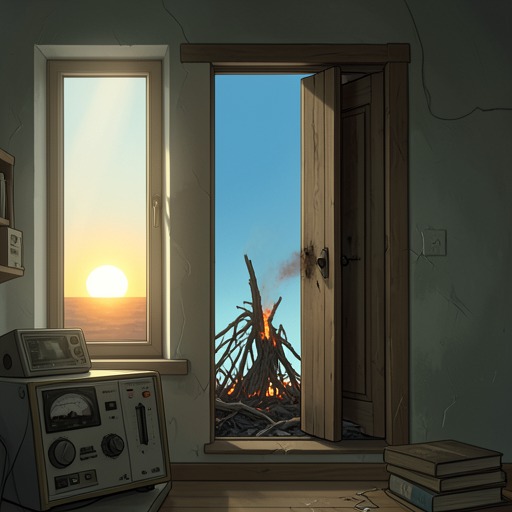
The sunrise is remembered through the room’s gradual illumination. Light first pales behind the lace curtains at the tops of the French windows, then gathers in brighter patches among the leaves outside. When the sun finally enters through the windows, the lace casts shadows across the stone floor and over Louis’s sleeping sister, including the shawl covering her shoulders and head. She pushes the shawl away when warmth reaches her without waking, and sunlight then falls directly across her closed eyes.
The light continues across the objects of the domestic interior. It gleams on the table where Louis’s sister rests her head on her arms, and it blazes in the water contained in the pitcher. Louis feels it first on his hands over the counterpane and then on his face. These details keep the farewell grounded in touch, household objects, sleeping bodies, and the familiar architecture of the plantation rather than in abstract symbolism alone. The last human dawn is not remote or monumental; it enters an ordinary room and reveals, with increasing clarity, the life Louis is about to abandon.
Farewell to Sunlight
Lying in bed, Louis thinks about everything Lestat has told him. As the sun reaches him, he says goodbye to the sunrise and leaves to become a vampire. The farewell is conscious, but it is not melodramatic in the form of a public declaration or ritual witnessed by others. Its privacy intensifies its finality: Louis alone understands that the light touching his hands and face will never touch him in the same way again.
When the boy later asks whether he misses the sunrise, Louis answers that he does not, because there are so many other things. The answer does not erase the scene’s tenderness. Instead, it places the lost dawn within the vast compensation and displacement of immortal existence. The sunrise remains uniquely memorable precisely because Louis says he remembers it completely while believing he remembers no other sunrise before it. Its singularity is produced by the irreversible boundary it marks.
Transformation and Irreversibility
The last sunrise leads directly into the process by which Lestat changes Louis. Lestat wants Pointe du Lac plantation for a mundane practical reason: his human father is blind and must not discover that his son is a vampire, while New Orleans has become difficult for Lestat to manage alongside his needs and his father’s care. At the plantation, the blind father is placed in the master bedroom, and Louis’s transformation begins.
The change consists of several acts rather than one simple instant. First, Lestat kills the overseer in his sleep while Louis watches and approves as proof of commitment. Louis finds this the hardest part because, although he has lost fear of his own death, he retains a profound regard for the lives of others and a newly sharpened horror of death after his brother’s death. Later, on the brick steps where his brother had fallen, Lestat drains Louis almost to the threshold of death and tells him that consciousness and will must keep him alive before offering his own blood. The last sunrise thus stands between two forms of awareness: the mortal consciousness that watches sunlight enter a familiar room and the vampiric consciousness that must survive the passage through blood, weakness, and deathlike surrender.
Memory and Narrative Significance
Louis’s recollection of the last sunrise interrupts the violent logic of transformation with a scene of stillness and visual accumulation. Elsewhere, death appears through broken skulls, rotting bodies, drained victims, and the destruction of remains; here, light moves carefully over curtains, leaves, water, fabric, and skin. The contrast makes the sunrise a counter-image to the deaths surrounding Louis’s conversion. It records what vampirism costs before the narrative turns fully toward what vampirism makes possible.
The expression also exposes Louis’s characteristic relation to change. He does not cross into immortality through simple triumph or uncomplicated desire. He carries guilt for his brother, disgust at killing, and uncertainty about the visions that preceded the death, yet he is drawn toward the extraordinary presence of Lestat and the promise of possibility. The final dawn condenses that conflict into one image: Louis remains physically within the human world while mentally preparing to leave it. When he says goodbye and goes out, the sunrise becomes both an ending and the first threshold of his immortal life.